Shiatsu: What Do We Actually Know?
An exploration of the research, the experience of Shiatsu, and where the two meet
Shiatsu: What Do We Actually Know?
An exploration of the research, the experience of Shiatsu, and where the two meet
I have practised Shiatsu for more than thirty years, and one of the things I value about it is that it is difficult to reduce to a simple formula.
People come for Shiatsu for all sorts of reasons. Some are experiencing physical tension or discomfort. Some are stressed or exhausted. Others simply feel out of balance and want some time in which they can stop, reconnect with themselves and be looked after.
As a practitioner, I have seen many people find Shiatsu enormously beneficial. But personal experience — however valuable — is not the same as scientific evidence.
So what does the research actually tell us?
What is Shiatsu?
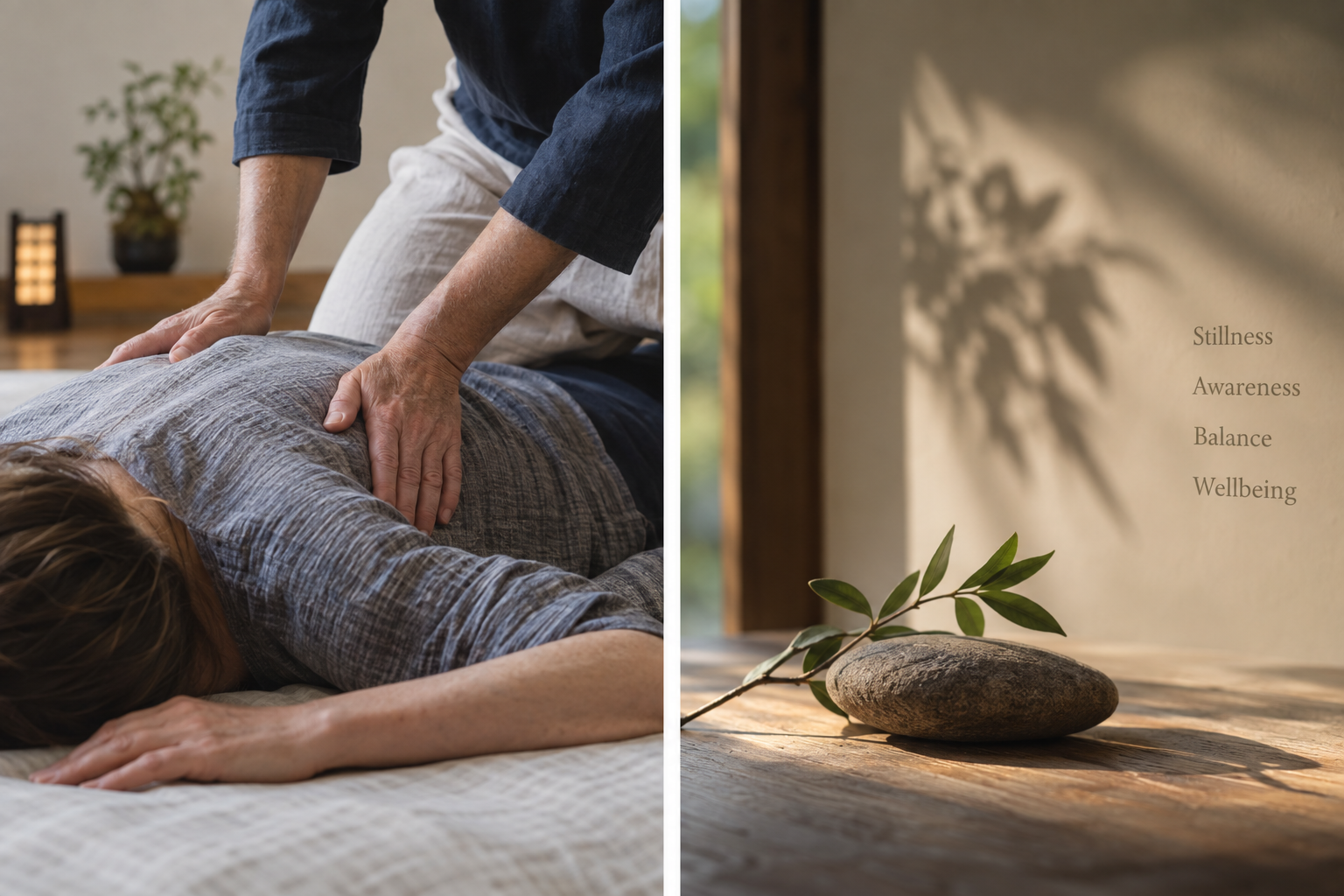
Shiatsu developed in Japan and literally means “finger pressure”. A treatment normally involves pressure applied with the fingers, thumbs, palms and sometimes other parts of the body, together with gentle stretches and movement.
Unlike many forms of massage, Shiatsu is generally given through clothing and without oils.
There are different schools and styles of Shiatsu. My own approach has been influenced by the traditional understanding of Ki — the movement and balance of energy within the body — and the meridian system familiar from East Asian medicine.
These ideas provide one way of understanding what happens during a treatment.
This is coupled with an understanding of anatomy and physiology, giving a modern approach to Shiatsu.
My rather poetic way of describing Shiatsu is to say that our body, mind and spirit are continually on a path to heal themselves. However, this ability to heal can become interrupted by life. A Shiatsu practitioner has learned how to “listen” to a person’s body holistically and nudge them back towards the path of healing.
Science asks whether measurable changes occur in people receiving Shiatsu and whether those changes can reliably be attributed to the treatment.
These are different ways of looking at the same experience, and I don't think we need to pretend that they are identical.
What does the research say?
The first thing to say is that there simply isn't enough high-quality research specifically into Shiatsu to make sweeping medical claims about it.
A major systematic review published in 2011 examined the available evidence for both Shiatsu and acupressure. Although the researchers found considerably more evidence for acupressure, they found only nine Shiatsu studies that met their criteria.
Their conclusion was that the evidence specifically for Shiatsu was insufficient in both quantity and quality.
That might sound disappointing, but it is important to understand what it means.
“We don't yet have good enough evidence” is not the same as “we have good evidence that it doesn't work.”
It means that larger, better-designed studies are needed.
Shiatsu and pain
One area in which there have been some interesting results is pain.
A small randomised controlled study published in 2019 looked at people with chronic lower-back pain. One group received standard care while another received Shiatsu in addition to standard care.
The results were mixed. At the first assessment there was no statistically significant difference between the groups on the study's primary measure of disability. At later follow-up, however, the Shiatsu group showed improvements in some measures of pain, disability and quality of life compared with the control group.
The researchers themselves were appropriately cautious and called for larger studies.
There has also been a small pilot study involving people with fibromyalgia which reported improvements in measures including pain, sleep and the impact of symptoms on daily life.
Again, these are encouraging findings rather than proof.
Small studies are useful because they can tell researchers whether something is worth investigating further, but they cannot carry the same weight as repeated, large-scale clinical trials.
Stress, tension and wellbeing
Another interesting piece of research looked at Shiatsu as it is actually practised in everyday life.
Researchers followed 948 people receiving Shiatsu from 85 practitioners in the UK, Austria and Spain. Participants reported their experiences over a six-month period.
Many reported improvements in symptoms, particularly those associated with tension or stress and musculoskeletal problems.
This study is interesting because it reflects real-world Shiatsu rather well. But there is an important limitation: it was an observational study, not a randomised clinical trial.
In other words, it tells us that people receiving Shiatsu commonly reported feeling better. It cannot establish that Shiatsu itself caused those improvements.
For me, both kinds of information are valuable, as long as we don't confuse one with the other.
Shiatsu isn't simply acupressure
This is another important point when reading research.
Shiatsu and acupressure are sometimes grouped together because both involve pressure on the body. There is considerably more research into acupressure, with studies suggesting possible benefits in areas including pain, nausea and sleep.
But Shiatsu is not simply the application of pressure to a collection of prescribed points.
A Shiatsu treatment may involve movement, stretching, sustained pressure, observation, touch and an ongoing response by the practitioner to the person receiving the treatment.
Research published since the original systematic review has specifically argued that Shiatsu and acupressure should be regarded as distinct techniques.
So we should be cautious about taking research into acupressure and simply claiming that it proves the effectiveness of Shiatsu.
Connection to Acupuncture
Shiatsu is sometimes referred to as “Acupuncture without needles”, meaning that similar points are activated in the body but using thumb pressure instead of needles. The crossover comes because both acupuncture and Shiatsu frequently use similar models and theories to explain their work.
The description of acupuncture without needles would better describe acupressure, owing to the wider scope of Shiatsu work using stretches, rotations and many other physical techniques.
There is more research into acupuncture, and there is evidence that it may be helpful for some conditions, particularly certain types of pain. Research suggests benefits for conditions including chronic low-back pain, osteoarthritis pain and some types of headache, although the size of the benefit and the quality of the evidence vary between conditions.
It would be fantastic if Shiatsu were to get the funding for research to explore the areas of benefit it may share with acupuncture, which practitioners have long recognised intuitively.
What does it mean for Shiatsu to “work”?
This is perhaps the question I find most interesting.
If someone comes to me with back pain and afterwards their pain has disappeared, it is tempting to say that Shiatsu has “worked”.
But suppose someone's pain remains, yet they sleep better that night, feel calmer, move more freely or feel more comfortable in their own body. Has the Shiatsu worked?
Or suppose someone arrives feeling overwhelmed and spends an hour simply becoming calm.
How do we measure that?
Clinical research quite reasonably needs measurable outcomes. Human experience is rather messier.
That doesn't mean we should abandon scientific scrutiny. Quite the opposite. I would like to see much more good-quality research into Shiatsu.
But it does mean that we should be careful not to assume that everything worthwhile about a treatment is necessarily captured by a single clinical measurement.
What I have noticed as a practitioner
After many years of giving Shiatsu, there are certain things I see repeatedly.
People often become noticeably quieter during a treatment. Breathing changes. Muscular tension sometimes softens. Someone who arrived talking rapidly about everything that has happened that week may gradually become calm.
People become aware of parts of their body they had almost stopped noticing.
That interests me.
We spend a remarkable amount of modern life in our heads — thinking, planning, worrying, remembering, looking at screens and responding to information.
Shiatsu is profoundly physical.
For an hour or so there is very little that the recipient has to achieve. They don't have to perform, analyse themselves or even make conversation.
They can simply experience what is happening.
I might describe some of what I feel during a treatment in terms of Ki and the meridians. Those concepts remain important to the way I understand and practise Shiatsu.
But I don't present them as scientifically established anatomical structures. They belong to a traditional model of understanding the body and our experience within it. As I am not a doctor, I certainly do not offer a medical diagnosis.
I am comfortable allowing those two perspectives — traditional and scientific — to sit alongside one another.
So, does Shiatsu work?
The most accurate answer at present is: we know less than I would like us to know.
There is some encouraging research. Small clinical studies have reported improvements in particular symptoms, and larger observational research suggests that many people receiving Shiatsu report benefits including reduced tension and improved wellbeing.
But the scientific evidence specifically for Shiatsu remains limited, and it isn't strong enough to justify claims that Shiatsu can cure or treat a long list of medical conditions.
That doesn't diminish my enthusiasm for Shiatsu.
If anything, I find the uncertainty interesting.
After many years as a practitioner, I don't need Shiatsu to be a miracle cure. I value it as a gentle and deeply human form of bodywork which can give someone the opportunity to slow down, experience touch, become more aware of their body and perhaps find a little more space within themselves.
Sometimes that can be surprisingly powerful.
And perhaps the most useful position is neither unquestioning belief nor automatic dismissal, but curiosity:
What happens when we stop for a while, pay attention to the body, and allow ourselves to receive?
A note about health
Shiatsu is a complementary therapy and should not be regarded as a substitute for appropriate medical diagnosis or treatment. If you have unexplained, severe or persistent symptoms, please seek advice from an appropriately qualified healthcare professional.
Cabo F et al. (2018) — Shiatsu and Acupressure: Two Different and Distinct Techniques